Where Engineering, Finance and Strategy Meet
Discover how infrastructure asset management connects engineering, finance and strategy to support stronger investment decisions and long-term infrastructure value.
Introduction
An engineer looks at a deteriorating bridge and sees condition, performance and technical risk.
A finance team sees capital requirements, operating costs and a budget already under pressure.
Leadership sees something else again: service delivery, organisational priorities and the question of where limited resources will create the greatest value.
They're looking at the same asset.
They're just asking different questions.
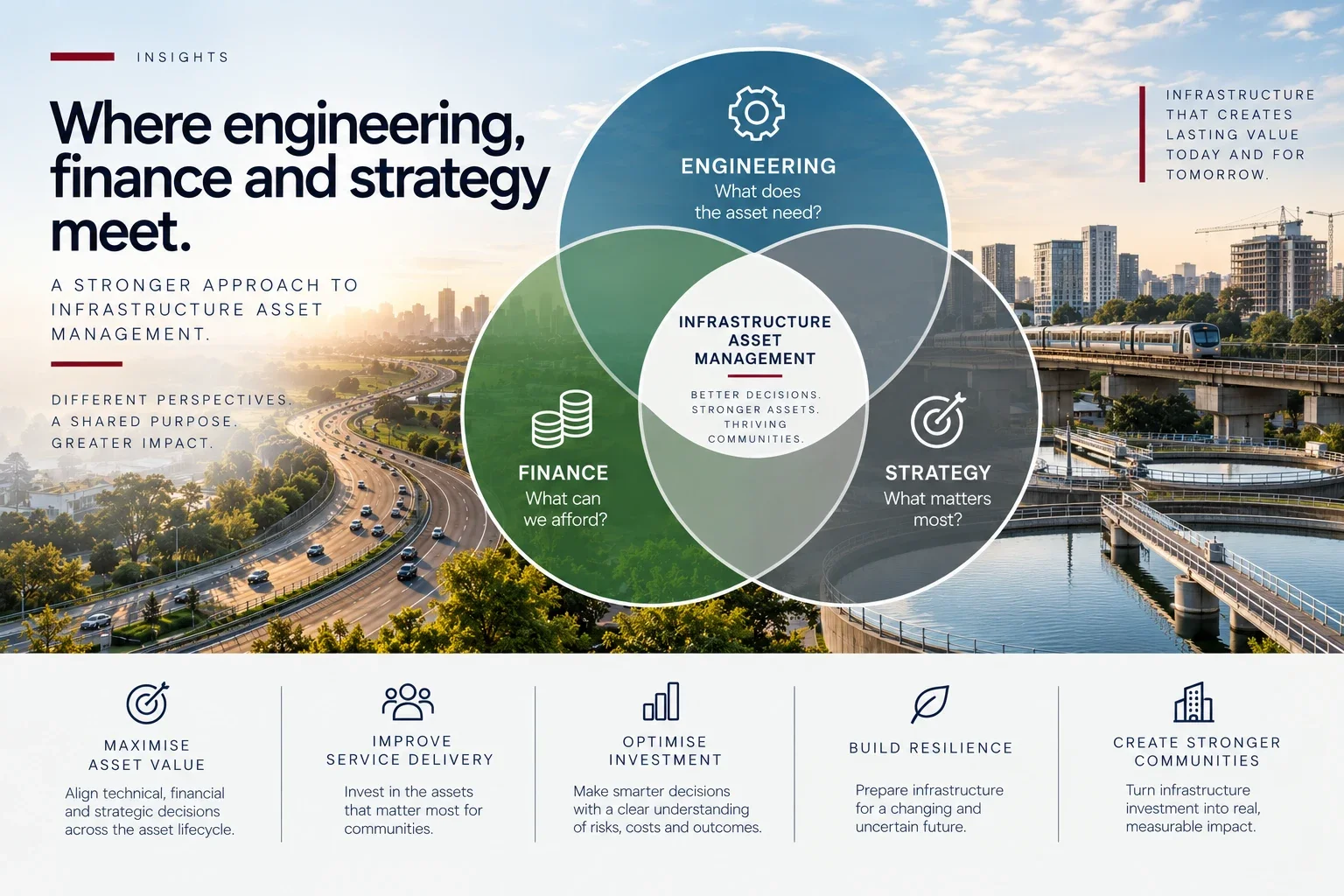
Engineering asks: What does the asset need?
Finance asks: What can we afford?
Strategy asks: What matters most?
Infrastructure asset management is where those questions meet.
Because deciding what to do with infrastructure isn't purely an engineering exercise. It isn't simply a budgeting exercise either. The strongest decisions happen when technical need, financial reality and strategic purpose are considered together.
Three Functions. Three Different Questions.
Each perspective brings something essential to the table.
Engineering understands how assets behave. It considers condition, deterioration, performance, technical requirements, safety and the interventions required to keep infrastructure functioning.
Finance brings another reality: resources are finite. Capital expenditure competes with other priorities, operating costs continue throughout an asset's life, and today's investment decisions create tomorrow's financial obligations.
Strategy provides direction. What services must the organisation deliver? Which outcomes matter most? Where is growth expected? What risks are acceptable? What infrastructure will be needed in five, ten or twenty years?
None of those perspectives is enough on its own.
A technically perfect solution that an organisation cannot afford isn't much of a solution.
Neither is the cheapest intervention if it compromises performance or creates greater costs later.
And infrastructure investment without a clear connection to organisational priorities risks spending money without creating enough value.
Where Decisions Become Disconnected
The challenge is that these conversations don't always happen together.
A technical team may identify an asset requiring rehabilitation, only for the project to reach budgeting without a clear explanation of its strategic importance.
Finance may see a large capital request without the condition and risk information needed to understand why delaying it matters.
Leadership may set ambitious service-delivery priorities without visibility of the infrastructure investment required to achieve them.
Everyone may be doing their job correctly.
The problem is the space between the jobs.
That gap can lead to projects being prioritised because funding happens to be available, maintenance being deferred without fully understanding the consequences, or capital decisions being made using upfront cost rather than long-term value.
Infrastructure asset management helps create a common language.
From Technical Need to Investment Priority
Suppose five infrastructure assets require intervention this year.
Engineering can identify their condition and recommend what technically needs to happen.
But funding exists for only two.
Now the decision changes.
Which assets support the most critical services? What happens if intervention is postponed? How quickly are they deteriorating? What would each intervention cost? Could maintenance safely extend an asset's life? Would rehabilitation create better value than replacement?
Suddenly, the decision involves cost, risk and performance.
And that is exactly where infrastructure asset management becomes valuable.
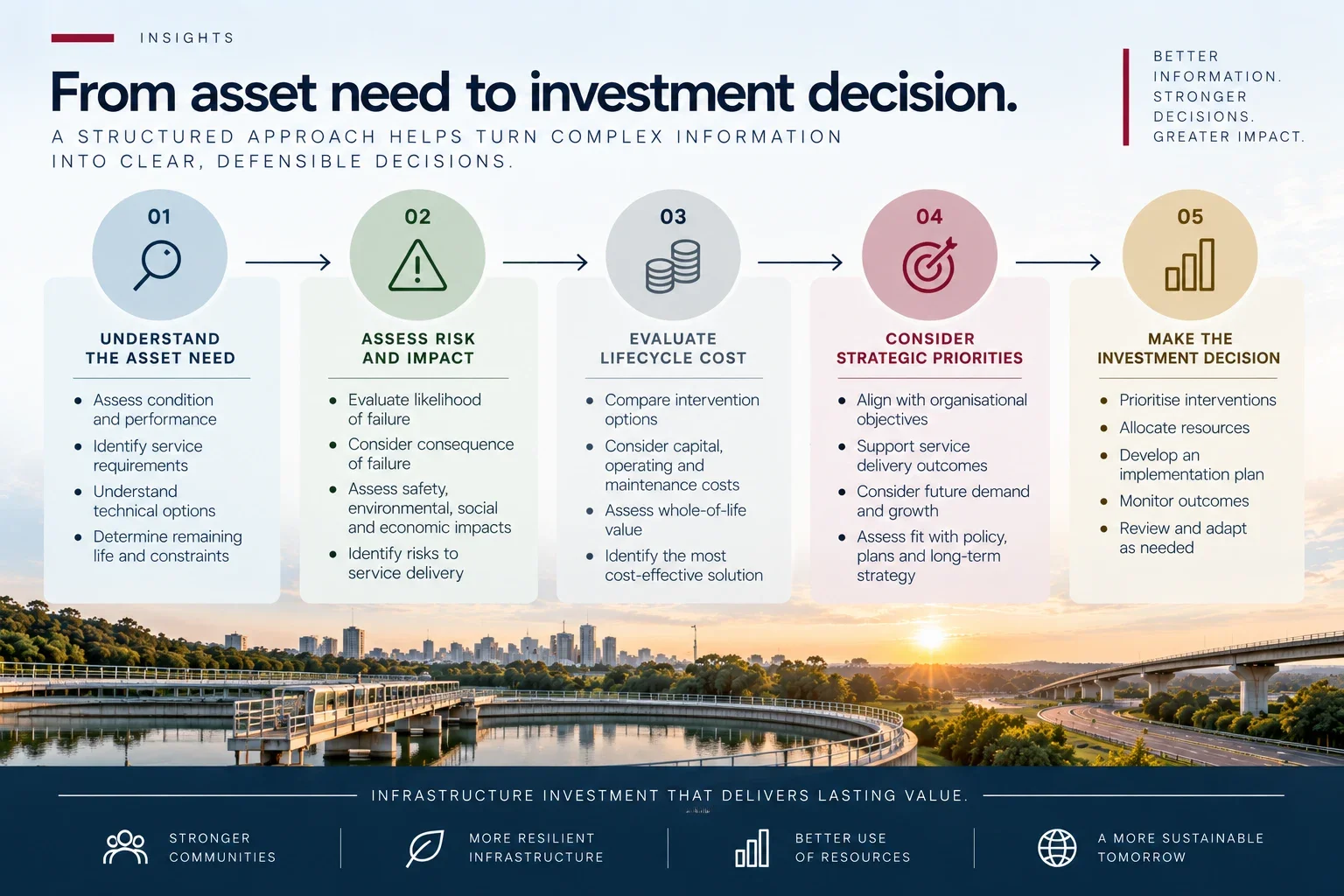
It creates a structured way to move from:
“This asset needs work.”
to:
“This is why this intervention should be prioritised now.”
That distinction matters when every project is competing for limited money.
The Cheapest Decision Isn't Always the Most Affordable
Finance naturally asks what an intervention will cost.
Asset management adds another question:
Over what period?
Infrastructure can remain in service for decades. The purchase or construction price is therefore only part of its financial story.
Operation costs money. Maintenance costs money. Inspections, repairs and rehabilitation cost money. Eventually, renewal or replacement does too.
A lower capital cost today may create higher operating or maintenance expenditure tomorrow.
Equally, a more expensive solution isn't automatically better simply because it promises a longer life.
The objective is to understand the trade-offs.
Lifecycle thinking gives engineering and finance a shared view of those trade-offs, allowing technical alternatives to be considered alongside their longer-term financial implications.
Risk Gives Priorities Context
Condition is important, but condition alone doesn't tell leadership where money should go first.
Imagine two assets in equally poor condition.
One has alternatives available if it fails. The other supports a critical service with no immediate backup.
Technically, both need attention.
Strategically, their importance may be very different.
Risk introduces that context by considering both the likelihood of something going wrong and the consequences if it does.
That helps organisations move beyond simply funding the assets in the worst physical condition.
It allows them to consider which problems matter most.
One Asset. One Decision. Multiple Perspectives.
This is where stronger infrastructure decisions begin to look different.
Instead of engineering developing one answer, finance evaluating another and leadership making the final call with incomplete information, the perspectives start connecting.
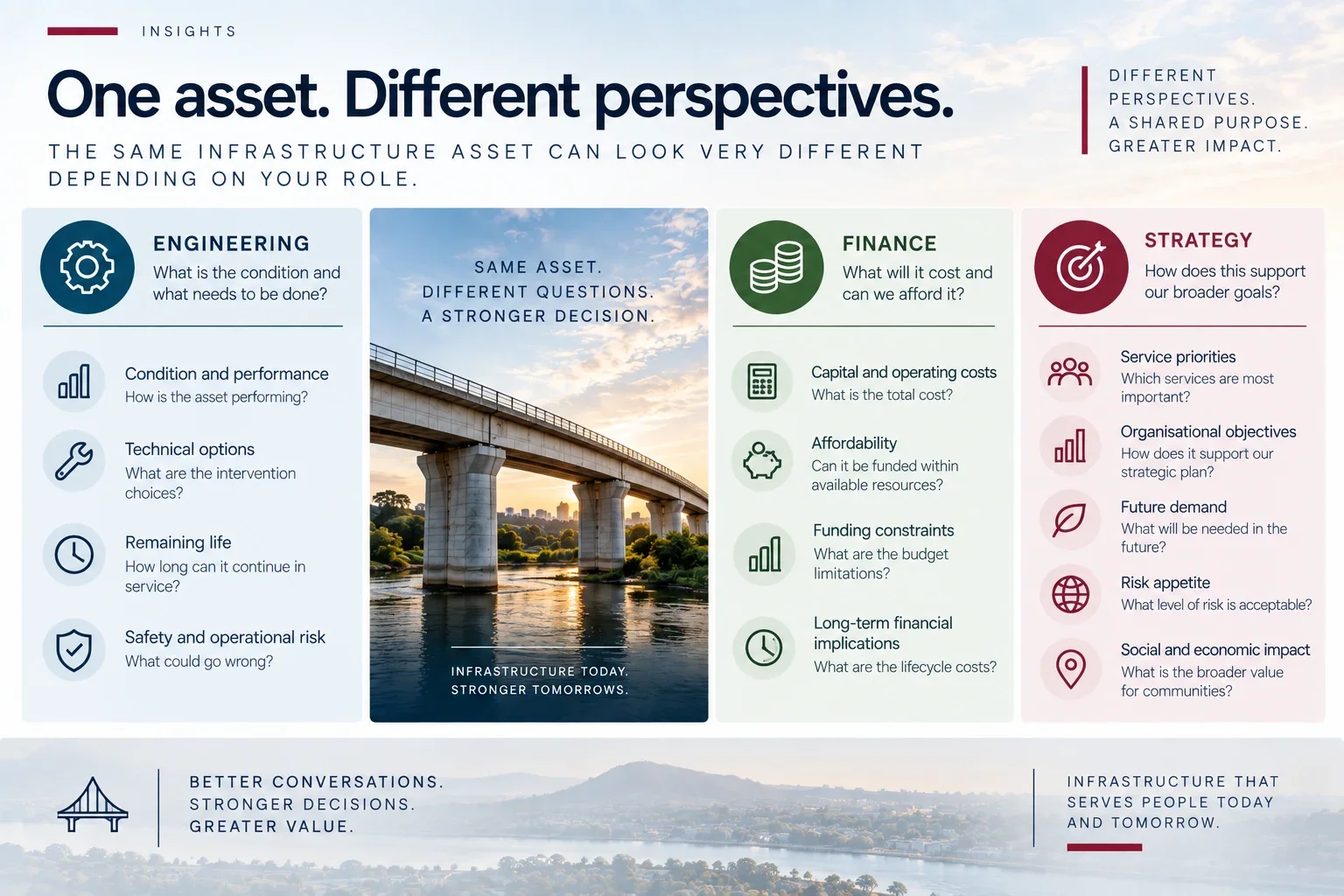
Engineering contributes:
- Condition and performance
- Technical options
- Deterioration and remaining life
- Safety and operational risk
Finance contributes:
- Capital and operating costs
- Affordability
- Funding constraints
- Long-term financial implications
Strategy contributes:
- Service priorities
- Organisational objectives
- Future demand
- Risk appetite and desired outcomes
Infrastructure asset management doesn't replace any of these functions.
It connects them.
Better Alignment Doesn't Mean Everyone Always Agrees
Good asset management won't remove difficult choices.
There will still be competing priorities. Budgets will still be constrained. Technical teams and financial teams won't always prefer the same option.
That's healthy.
The objective isn't automatic agreement.
It's ensuring that disagreement happens around the same evidence, objectives and trade-offs.
A decision to defer an intervention can then be made with a clear understanding of the associated risk.
A decision to spend more upfront can be supported by lifecycle evidence.
A project can be deprioritised because another investment contributes more directly to critical service outcomes.
That creates something more valuable than consensus.
It creates defensible decisions.
Asset Management Is Ultimately About Value
Infrastructure exists for a reason.
Roads connect people and economic activity. Water infrastructure supports communities and businesses. Electricity networks enable homes, services and industry. Public buildings provide places where essential functions happen.
The asset itself isn't the final outcome.
The service it enables is.
That's why effective infrastructure asset management can't live exclusively in an engineering department, a finance spreadsheet or a strategic plan.
It sits at the intersection.
When engineering understands the financial constraints, finance understands the technical consequences and strategy provides a clear direction, infrastructure investment becomes more than a list of projects.
It becomes a way of translating limited resources into long-term value.
Frequently Asked Questions
Q: What is infrastructure asset management?
A: Infrastructure asset management is a structured approach to managing physical infrastructure over its lifecycle so that assets support required services while balancing performance, cost and risk.
Q: Why should finance be involved in infrastructure asset management?
A: Asset decisions create both immediate and long-term financial implications. Finance helps assess affordability, capital and operating expenditure, funding constraints and the lifecycle consequences of different investment options.
Q: What role does engineering play in asset management?
A: Engineering provides technical understanding of asset condition, performance, deterioration, safety, intervention requirements and the technical consequences of different decisions.
Q: How does asset management support strategic planning?
A: It connects infrastructure needs with organisational objectives, service requirements, risk and future demand, helping leaders understand which investments are most relevant to strategic outcomes.
Q: What makes a good infrastructure investment decision?
A: Strong decisions consider more than one factor. Technical performance, lifecycle cost, risk, affordability, service outcomes and strategic priorities may all need to be evaluated together.
Different Perspectives. One Infrastructure Decision.
Engineering knows what an asset needs.
Finance understands what resources are available.
Strategy determines what the organisation is trying to achieve.
The opportunity lies in bringing those perspectives together before the investment decision is made.
Because infrastructure decisions rarely belong to one department.
They affect budgets, services, risks and communities for years to come.
And when technical evidence, financial reality and strategic priorities meet, organisations can move beyond simply asking:
“Can we fund this project?”
towards a much stronger question:
“Is this the right investment, at the right time, for the outcomes we're trying to achieve?”
Bringing Technical, Financial and Strategic Decisions Together?
Strong infrastructure decisions depend on seeing the whole picture — asset condition, performance, risk, lifecycle cost and organisational priorities.
Talk to Infratec about strengthening the information and planning that support better infrastructure asset management decisions.