Lifecycle Costing for Better Capital Decisions
Discover how lifecycle costing helps infrastructure leaders look beyond upfront costs and make stronger capital, maintenance and long-term investment decisions.

Introduction
The cheapest infrastructure option today isn’t always the cheapest option tomorrow.
A lower construction cost can look attractive when budgets are tight. But infrastructure doesn’t stop costing money once it has been built. It needs to be operated, inspected, maintained, repaired and, eventually, renewed or replaced.
That’s why a capital decision based only on the price of getting an asset into the ground can tell only part of the story.
Lifecycle costing widens the lens.
Instead of asking, “What will this cost us now?” it asks a more useful question:
“What is this asset likely to cost us over the period we expect it to serve us?”
That shift can change which investment makes the most sense.
The Lowest Price Can Carry a Higher Cost
Imagine two infrastructure options designed to provide the same service.
Option A has the lower upfront cost but requires more frequent maintenance, consumes more resources during operation and may need major rehabilitation sooner.
Option B costs more initially but is expected to last longer and requires less intervention over its useful life.
Looking at capital expenditure alone, Option A wins.
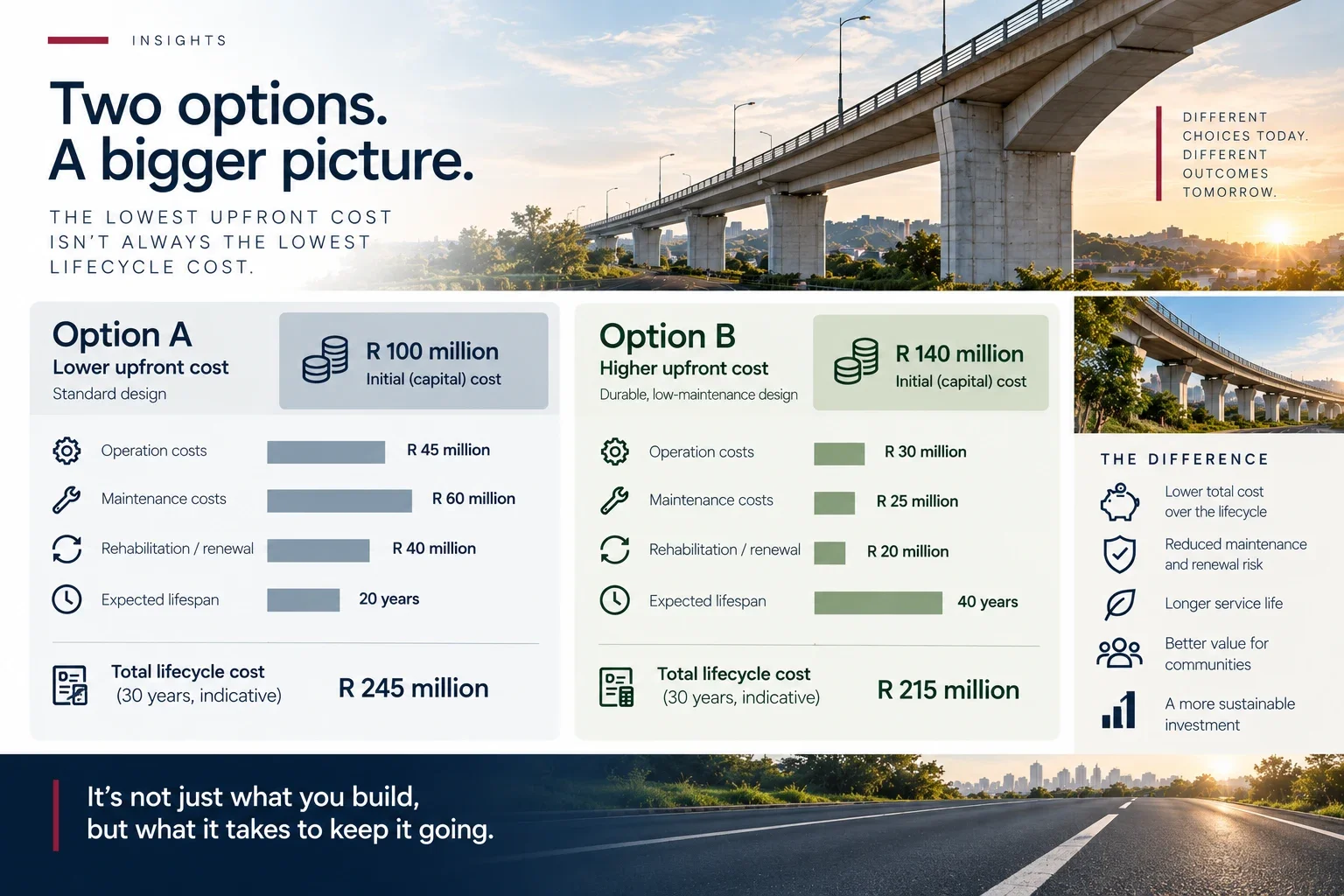
Looking at the whole picture? The answer may be very different.
That’s the purpose of lifecycle costing: bringing future costs into the conversation before today's investment decision locks them in. South African quantity-surveying guidance similarly describes lifecycle costing as considering costs across an asset's operating life rather than concentrating solely on its initial acquisition or construction price.
What Does Lifecycle Costing Actually Include?
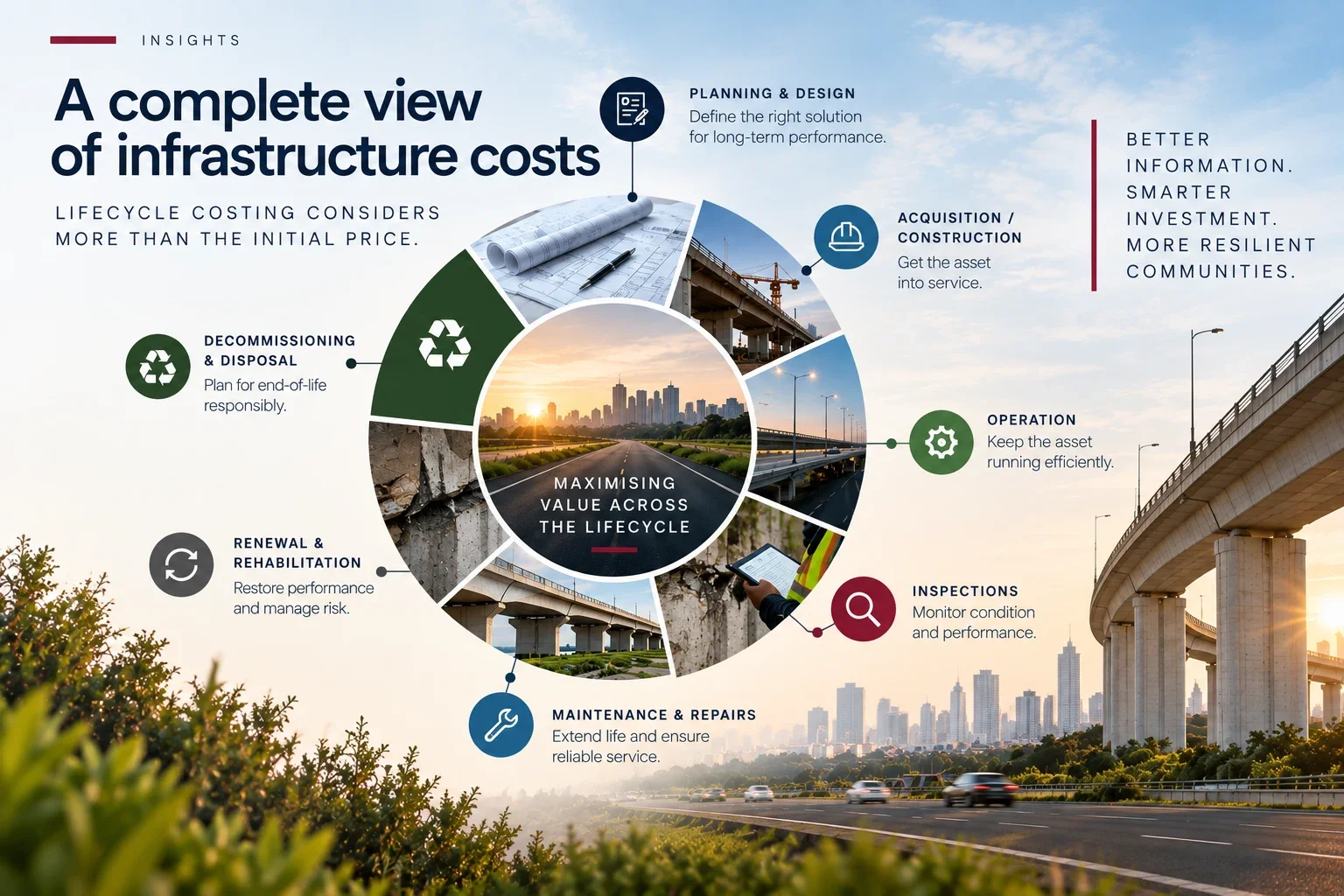
The calculation will depend on the asset, available information and purpose of the analysis, but the cost picture may include:
- Planning and design
- Acquisition or construction
- Operation
- Routine and preventative maintenance
- Inspections
- Repairs
- Rehabilitation and renewal
- Component replacement
- Energy and other resource consumption
- Decommissioning or disposal
- Residual value
The point isn't to predict every future rand perfectly.
No one can.
The goal is to make assumptions visible and compare realistic alternatives on a more consistent basis.
CAPEX Is the Beginning, Not the Whole Story
Capital expenditure tends to command attention because it is immediate, visible and often substantial.
Operational expenditure behaves differently. Maintenance costs arrive gradually. Components wear out at different rates. Energy costs accumulate. Rehabilitation may only become necessary years after the original project team has moved on.
Yet those future costs belong to the same infrastructure decision.
A cheaper asset doesn't automatically mean cheaper infrastructure.
Lifecycle costing creates a bridge between CAPEX and OPEX, helping decision-makers understand how today's capital choices can influence tomorrow's operating and maintenance obligations.
That matters particularly for infrastructure expected to remain in service for decades.
Better Capital Planning Starts With Better Questions
Lifecycle thinking changes the conversation around investment.
Instead of simply asking which project has the lowest initial cost, leaders can ask:
- What level of service must the asset provide?
- How long is it expected to remain useful?
- What maintenance will it require?
- When are major renewals likely to occur?
- What happens if maintenance is delayed?
- Which alternative offers stronger value over the chosen analysis period?
Those questions bring technical and financial thinking closer together.
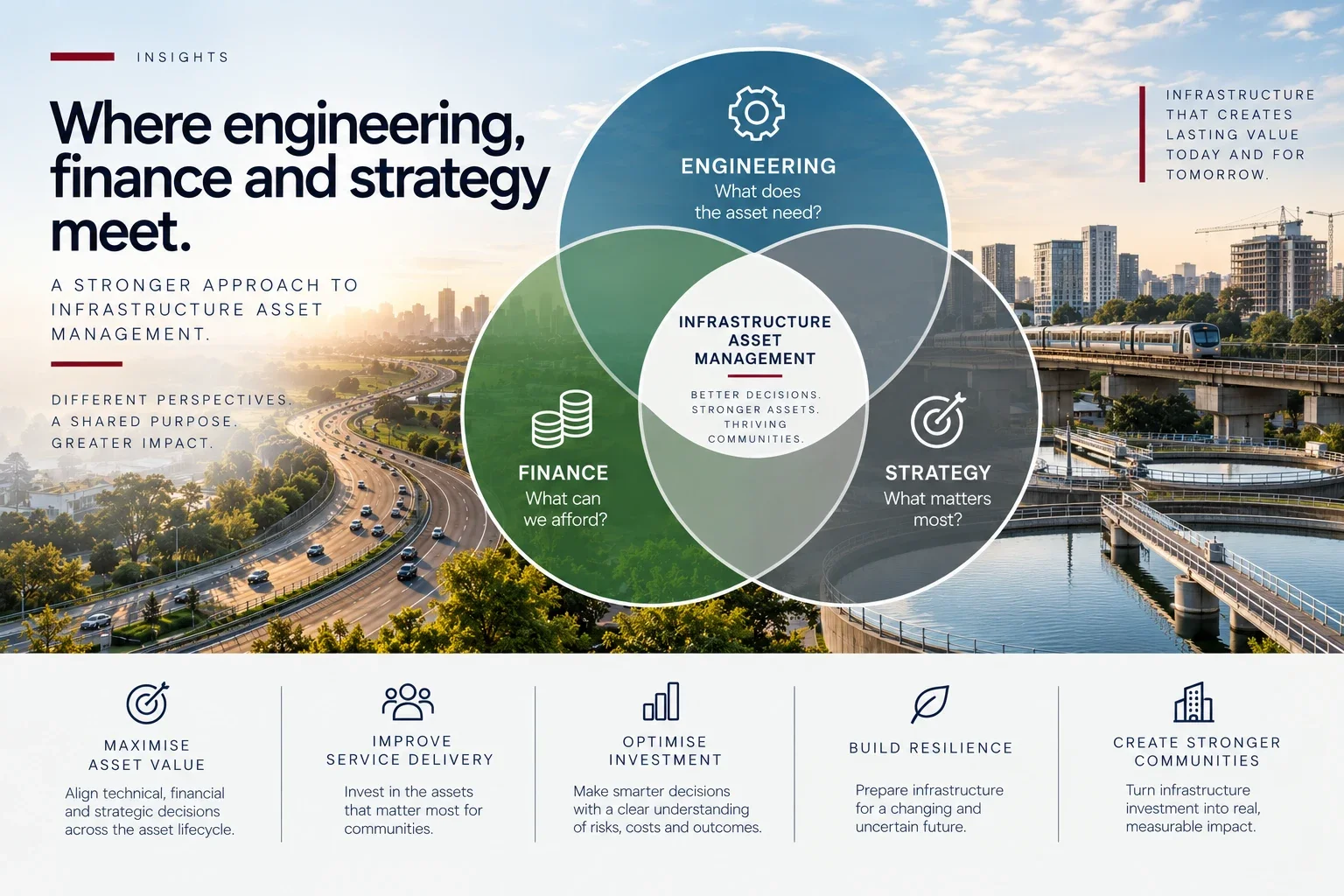
Engineers may understand how an asset is likely to deteriorate. Maintenance teams know where recurring problems occur. Finance teams understand affordability and future budget pressures.
Lifecycle costing gives those perspectives somewhere to meet.
The Spreadsheet Isn't the Strategy
Lifecycle models can become sophisticated. Discount rates, inflation assumptions, deterioration curves, maintenance intervals and residual values can all influence the result.
But complexity isn't automatically accuracy.
A detailed model built on weak assumptions can create the illusion of precision.
Good lifecycle costing therefore depends on credible asset information, realistic assumptions and transparent reasoning. Decision-makers should be able to see what has been included, what has been assumed and where uncertainty remains.
Sometimes the most useful result isn't a single number.
It's discovering which assumptions could change the decision.
That is where scenario and sensitivity analysis become valuable: what happens if maintenance costs rise, deterioration happens sooner than expected or the asset remains in service longer?
From Short-Term Savings to Long-Term Value
Infrastructure owners rarely have unlimited capital.
The challenge is therefore bigger than choosing the technically strongest option. Organisations need to decide how limited resources can deliver acceptable performance while managing cost and risk over time.
Lifecycle costing doesn't make that decision automatically.
It gives leaders better evidence with which to make it.
That can mean recognising when higher upfront investment is justified. It can also show when an expensive solution provides little additional long-term value.
The objective isn't to spend more.
It's to understand what you're paying for — now and later.
Frequently Asked Questions
Q: What is lifecycle costing?
A: Lifecycle costing is a method of assessing costs associated with an asset across a defined period of its life, rather than considering only its initial purchase or construction cost.
Q: Why is lifecycle costing important for infrastructure?
A: Infrastructure can remain in service for decades and continue generating operating, maintenance, renewal and eventual disposal costs. Lifecycle costing helps bring those future implications into investment decisions.
Q: Is lifecycle costing the same as whole-life costing?
A: The terms are closely related but can have different technical scopes depending on the methodology being used. Both encourage decision-makers to look beyond upfront expenditure. RICS guidance, for example, distinguishes lifecycle and whole-life costing while providing standards and definitions for their application to new and refurbished constructed assets.
Q: Does the cheapest lifecycle option always have to be selected?
A: No. Cost is one part of infrastructure decision-making. Performance, service requirements, risk, resilience, affordability and other strategic considerations may also influence the final decision.
Q: Can lifecycle costing be used for existing infrastructure?
A: Yes. It can support decisions about maintenance, rehabilitation, replacement and alternative intervention strategies for existing assets. South African research has, for example, applied lifecycle costing to maintenance decisions involving railway rolling stock.
Better Capital Decisions Look Beyond Day One
A capital budget tells you what an organisation can spend today.
A lifecycle perspective asks what today's decision could mean tomorrow.
That distinction matters.
Infrastructure that appears affordable at procurement can become expensive to operate. An intervention that initially looks costly may avoid repeated repairs or premature replacement. And sometimes the best long-term decision is neither the cheapest nor the most expensive option on the table.
The value lies in seeing the trade-offs before committing the money.
Because the real cost of infrastructure isn't simply what it costs to build.
It's what it costs to keep delivering.
Planning Beyond the Initial Price?
Infratec's current service positioning includes infrastructure asset management and lifecycle-related planning, so this CTA should ultimately be aligned with the exact wording the client wants used on the redesigned site.
Talk to Infratec about turning infrastructure information into better-informed long-term asset and capital planning decisions.