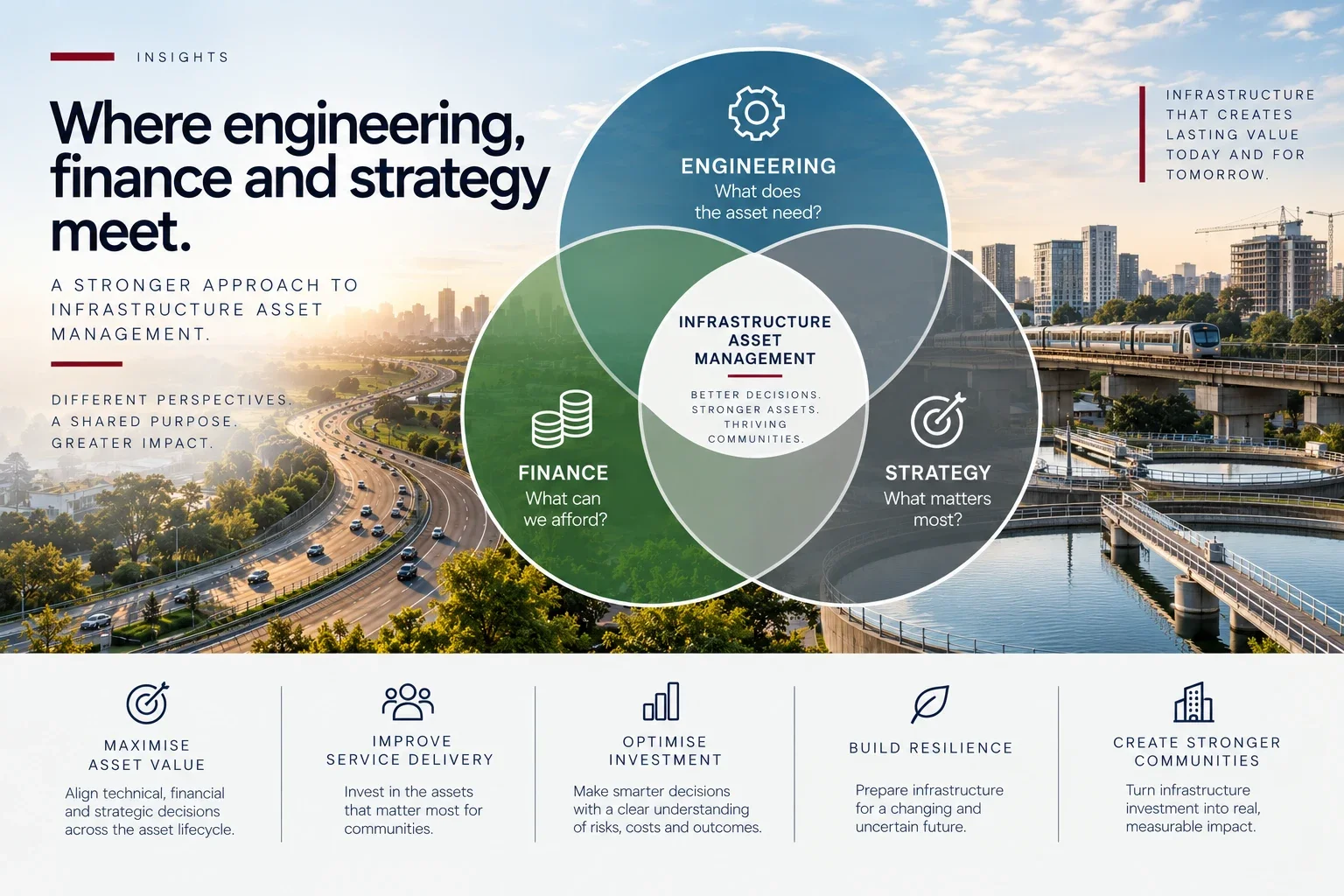
Building an Infrastructure Asset Register Leaders Can Trust
Discover how a reliable infrastructure asset register turns scattered asset data into practical intelligence for better planning, budgeting, risk management and long-term infrastructure decisions.

Introduction
Ask a simple question: What infrastructure do we own, where is it, and what condition is it in?
The answer should be straightforward. In practice, it often isn’t.
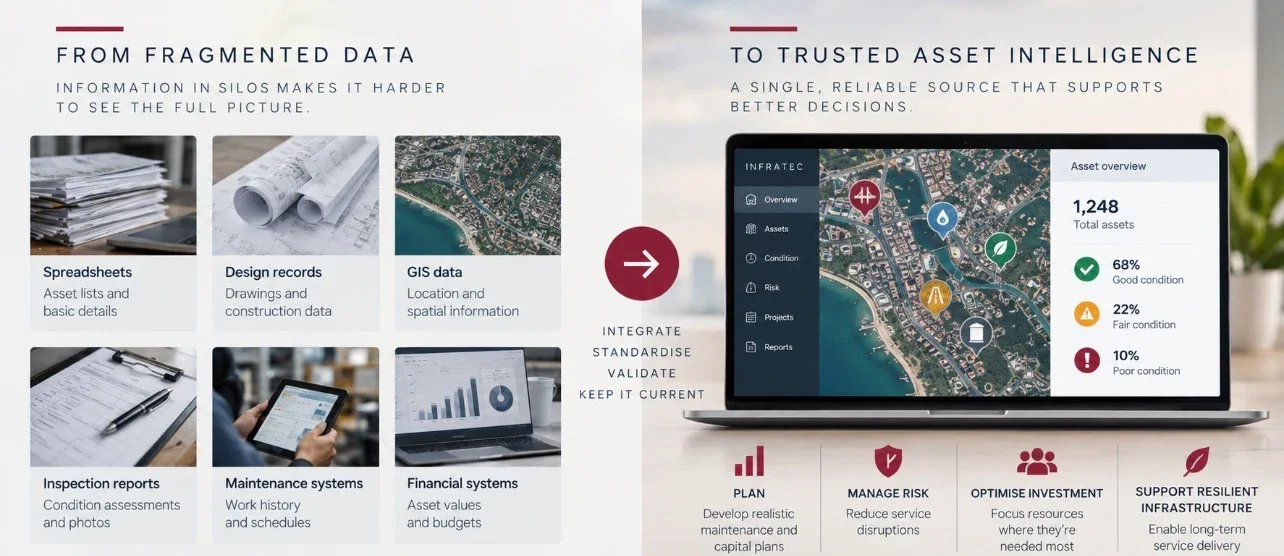
Infrastructure information can sit across spreadsheets, GIS platforms, financial systems, inspection reports and the institutional knowledge of people who’ve worked with the assets for years. One system may say a road was rehabilitated five years ago while another still carries older information. An asset may appear in financial records but lack reliable condition data. Somewhere else, a maintenance team may know exactly which pump causes recurring problems, yet that knowledge hasn’t made its way into the formal dataset.
That’s where an infrastructure asset register becomes more than an inventory. It becomes a foundation for effective infrastructure asset management.
Done properly, it creates a trusted foundation for deciding where money goes, what needs attention and which risks can’t afford to be ignored.
An Infrastructure Asset Register Isn’t Just a List
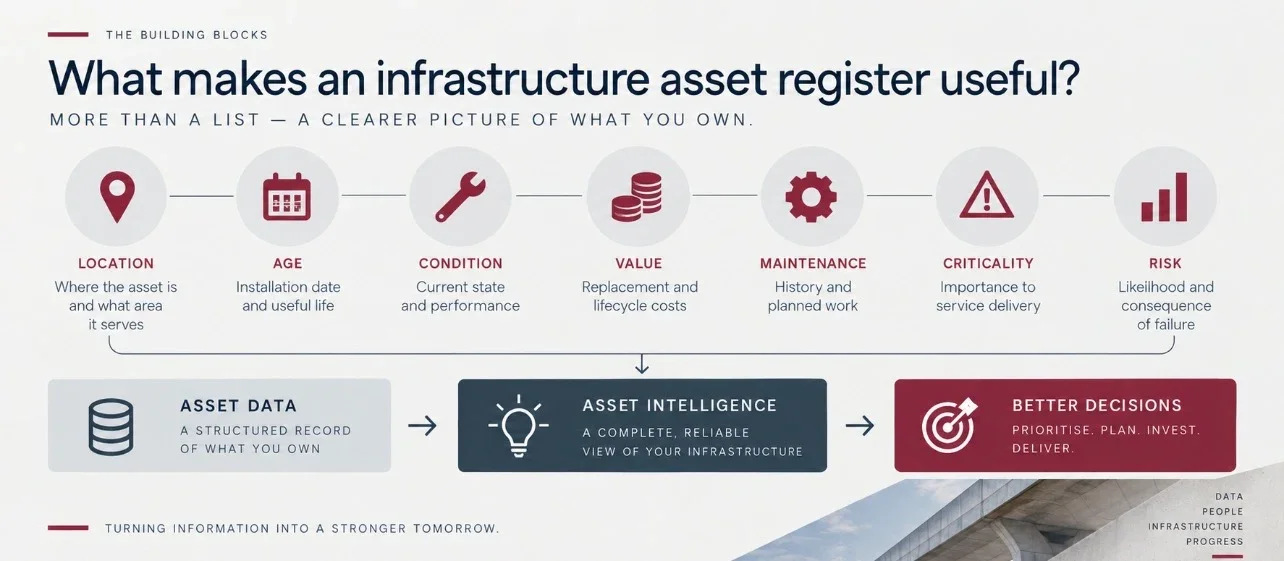
At its simplest, an asset register records the infrastructure an organisation owns or controls. But a useful register needs to answer more than “What do we have?”
Depending on the asset class and purpose, useful information may include:
- Asset type and description
- Geographic location
- Age or installation date
- Current condition
- Remaining useful life
- Replacement value
- Maintenance and inspection history
- Criticality and risk information
- Links to photographs, drawings or GIS data
- Responsible department or asset owner
Put together, those fields start telling a story.
A bridge isn’t simply Bridge 0047. It’s an asset in a particular location, of a certain age and condition, supporting a particular level of service and with real consequences should it fail.
That’s the difference between asset data and asset intelligence.
Why Should Leaders Trust the Data?
Here’s the catch: having more data doesn’t automatically mean having better information.
An impressive database filled with outdated, duplicated or inconsistent records can create false confidence. And that’s arguably more dangerous than openly admitting that information is missing.
Leaders may use asset information to approve maintenance programmes, motivate capital budgets, assess infrastructure risk or decide whether rehabilitation can wait another year. Those decisions carry real financial and service-delivery consequences.
So trust matters.
A dependable infrastructure asset register should be:
Accurate. Records should reflect assets that actually exist and their known characteristics.
Current. Condition, maintenance and lifecycle information needs updating as assets change.
Consistent. Assets should follow agreed naming, classification and data standards.
Traceable. Decision-makers should be able to understand where important information came from.
Useful. Collecting data simply because it can be collected creates clutter. Information should support an operational, financial, regulatory or strategic purpose.
From “What Do We Own?” to “What Should We Do Next?”
This is where things get interesting.
Once reliable asset information is combined with condition, criticality, risk and cost information, the conversation changes.
Instead of:
“We have 500 kilometres of road.”
Decision-makers can begin asking:
“Which sections are deteriorating fastest, which are most critical to service delivery, and where would intervention create the greatest value?”
That’s a far more useful question.
Consider two assets in poor condition. One serves a relatively low-demand area and has manageable consequences if it temporarily fails. The other supports a critical service with few alternatives.
Their condition ratings may look identical on paper. Their risk profiles aren’t.
A mature register helps provide the evidence needed to distinguish between them.
The Cost of “We’ll Fix the Data Later”
Poor asset information has a habit of showing up at the worst possible moment.
Budget season arrives. A major asset fails. Funding becomes available and projects must suddenly be prioritised. Someone asks for the replacement value of a network.
Cue the frantic spreadsheet hunt.
Without dependable information, organisations can find themselves making expensive decisions using assumptions, incomplete records or data collected for an entirely different purpose.
There’s another problem too: infrastructure keeps ageing while the database sits still.
A once-off asset verification exercise won’t create lasting intelligence if nobody maintains the information afterwards. Building the register is therefore only half the job.
The real question is: How will the information stay trustworthy?
Building an Infrastructure Asset Register That Gets Better With Age
A useful register doesn’t need to become a monster database overnight.
A practical approach starts with the decisions the organisation needs to make and works backwards.
That means asking:
- What assets are important to our objectives and services?
- What decisions must the data support?
- Which information is essential for those decisions?
- Where does that information currently exist?
- Who is responsible for validating and updating it?
- How will information from inspections, maintenance and projects flow back into the register?
Technology matters here, but it isn’t a silver bullet.
GIS, mobile field applications, dashboards, sensors and integrated asset-management platforms can make information easier to collect, analyse and visualise. Yet even sophisticated technology struggles with unclear ownership, inconsistent standards and poor data governance.
Or, put simply: a shiny dashboard can’t rescue bad data.
Asset Intelligence Is Ultimately Decision Intelligence
The real value of an asset register isn’t the number of records it contains.
It’s the quality of decisions those records support.
Reliable asset information can strengthen maintenance planning, risk assessment, lifecycle planning, capital prioritisation and long-term budgeting. It can also help technical and financial teams work from a shared picture rather than competing versions of reality.
For infrastructure leaders dealing with ageing assets, competing priorities and limited budgets, that’s no small thing.
The question shifts from “Do we have an asset register?” to something far more meaningful:
“Do we trust it enough to make our next major infrastructure decision?”
Frequently Asked Questions
Q: What is an infrastructure asset register?
A: An infrastructure asset register is a structured record of infrastructure assets owned or controlled by an organisation. It can include information such as location, type, age, condition, value, useful life, maintenance history and criticality.
Q: Why is an infrastructure asset register important?
A: It provides a reliable information base for maintenance planning, risk management, budgeting, lifecycle planning and infrastructure investment decisions.
Q: How often should an asset register be updated?
A: There isn’t one suitable interval for every asset. Updates should reflect material changes, including inspections, maintenance, rehabilitation, new construction, disposal and changes in condition or asset information.
Q: Can GIS be linked to an asset register?
A: Yes. GIS can connect asset records to geographic locations, helping organisations visualise infrastructure networks and combine spatial information with condition, maintenance and other asset data.
Q: What makes asset data trustworthy?
A: Trustworthy asset data is sufficiently accurate, current, consistent, traceable and relevant to the decisions it supports. Clear responsibility for collecting, validating and updating information is equally important.

Good Infrastructure Decisions Start With Data You Can Trust
An infrastructure asset register shouldn’t exist simply to satisfy a reporting requirement. Its real value appears when leaders can confidently use it to decide what needs attention, where investment should go, which risks require action and how infrastructure should be managed over the long term.
That starts with getting the fundamentals right: knowing what you own, understanding its condition, establishing clear responsibility for the information and keeping that information current.
Because a register filled with data isn’t necessarily an asset.
A register that helps you make better decisions is.
Can You Trust Your Asset Data?
If your organisation is working with fragmented asset information, outdated records or infrastructure data that isn’t giving decision-makers the clarity they need, Infratec can help turn asset information into practical intelligence.
Talk to Infratec about building a stronger foundation for your infrastructure asset management decisions.